Gems: Unreal Engine 5 Game Development
Abstract
Gems is a first-person collection and platforming prototype developed in Unreal Engine 5. The project integrates player locomotion, collectible tracking, environmental hazards, triggered platforms, sequential level progression, and a terminal win state within a compact gameplay loop. Two stages provide distinct visual conditions and increasing interaction complexity: an introductory daylight stage containing five gems, followed by a nighttime stage containing twelve gems and a pressure-plate puzzle. The completed prototype demonstrates an end-to-end progression from initial instruction to objective completion.
Design Objectives
The primary objective was to construct a small but complete game loop rather than a broad collection of disconnected mechanics. The design therefore emphasized three requirements:
- a clearly observable objective through a gem counter;
- progressive introduction of movement, hazards, and environmental interactions; and
- an explicit transition from level entry to a final success state.
Instructional prompts communicate the controls and identify spike hazards at the point where the corresponding information becomes relevant. This just-in-time presentation limits the amount of interface text while preserving sufficient guidance for traversal.
System and Level Design
The first stage is a daylight environment organized around a stylized village. Five gems define the traversal route, and each collection event updates an on-screen counter. Completion of this set advances the player to the second stage.
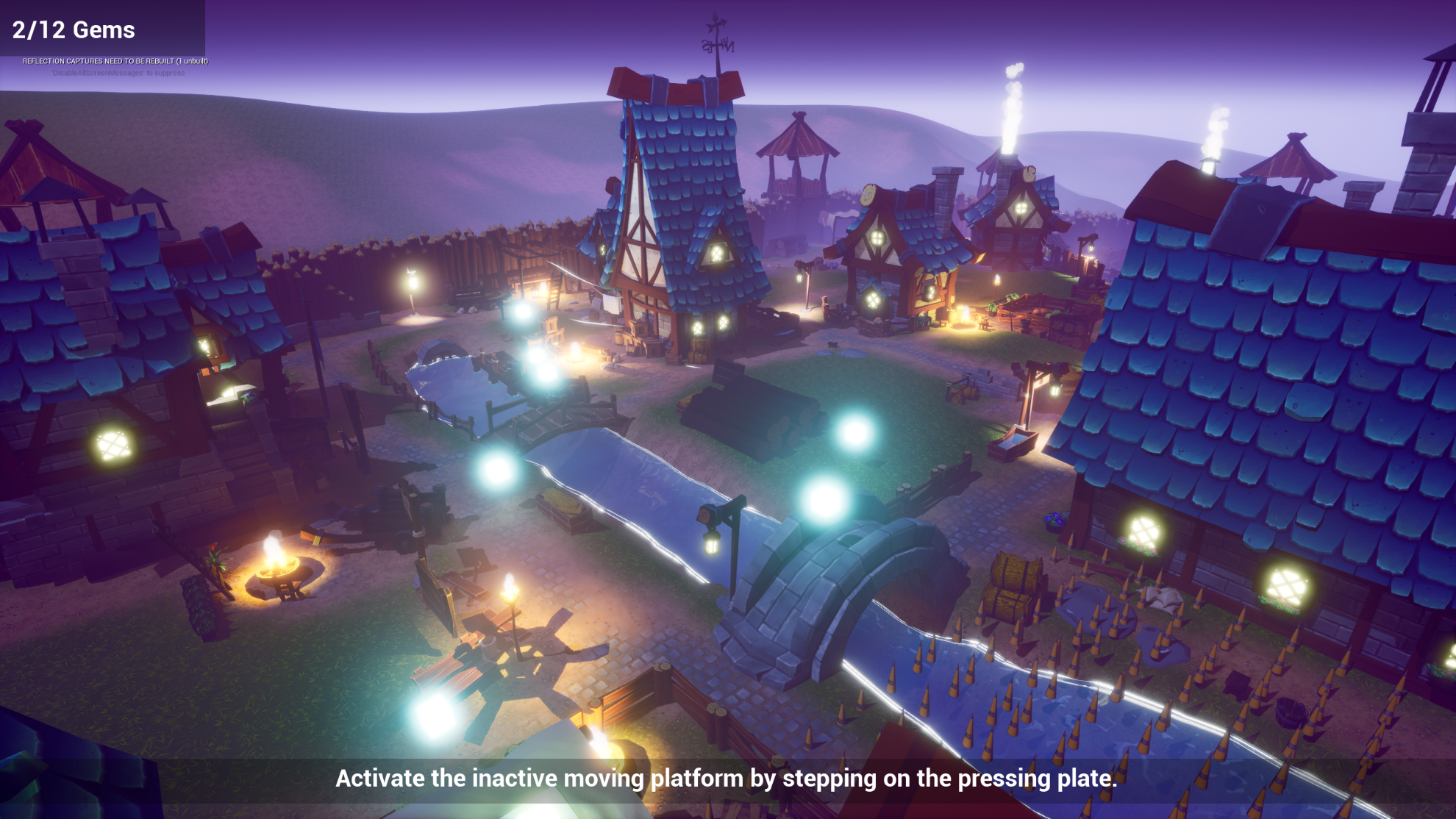
The second stage uses nighttime lighting and contains twelve additional gems. It also introduces an environmental dependency: selected platforms remain stationary until the player activates the corresponding pressure plate. Progress consequently requires identifying the trigger, relating it spatially to the platform, and traversing the activated route. Collection of the final gem produces a “You Win” screen and a wide view of the village.
The environment was assembled with the FANTASTIC - Village Pack. Houses, fences, trees, roads, and props were arranged into two visually distinct stages. Daylight improves the visibility of the introductory route and hazards, whereas the nighttime stage uses village illumination and glowing gems, pressure plates, and platforms as navigational landmarks.
Demonstration
The demonstration was recorded from Unreal Editor. It presents both stages, the collectible counters, spike hazards, pressure-plate interaction, moving platforms, and final win state.
Limitations and Discussion
The result is a functional prototype rather than a production-complete game. Its scope is limited to collection and traversal; it does not include combat, inventory management, or a broader progression system. The project also relies on an existing environment asset pack, with the original work concentrated on scene arrangement and integration of the gameplay sequence. Evaluation is qualitative and based on completion of the demonstrated interaction path rather than a formal user study.
Conclusion
The prototype satisfies the specified two-stage progression and interaction requirements, including collectible tracking, environmental hazards, triggered traversal, and a terminal success state. Formal usability evaluation remains future work, together with broader level variety and additional mechanics.